Copyright © 2005 Gene Michael Stover. All rights reserved. Permission to copy, store, & view this document unmodified & in its entirety is granted.
These are my notes about the online game called Final Fantasy XI. It is a graphical MUD produced by Square Enix. There are client programs for Playstation 2 & for Microsloth Winders.
The most common battle tactic for a party if six is ``camp-&-pull''. The party finds a location & labels it the camp. Five of the party members stay there the entire time. One party member is designated the puller. When there is no battle & everyone is healed enough for the next battle, the puller runs away from camp, finds a beastie, whacks it over the head to get its attention, & runs back to camp where the six members of the party ambush the poor beastie.
The important roles during a battle are:
Having spent much of my time as a party's healer & observing different tanks in action, I highly recommend against using a Tarutaru as a tank. I don't mean to be funny, & I like Tarus in general, but they are terrible tanks.
Also, I recommend against a backup tank. Have just one tank. Let him take all the hate because your healer's duty is easier if she just has to worry about one character (the tank). Two tanks make it that much more difficult for the healer, & an ineffective tank means that every party member will take damager, which turns your healer's job into a frenzied nightmare.
The only
reason for a backup tank, in my opinion, is if your single
tank cannot take his share of damage in the fight even
with the healer's help (like if you don't have a healer).
In that case, get two tanks, but instead of designating
one of them a backup tank, designate both of them
co-tanks. They should try to split the hate evenly so
that each taks  of the damage during the
fight. Hopefully each can survive the fight that way.
of the damage during the
fight. Hopefully each can survive the fight that way.
I like to refer to tanks as ``hate hogs''.
A White Mage is the primary job for this role. A backup healer works well, & a Red Mage or a character with White Mage as her subjob can fill that role while filling others if that player can pay attention.
If the tank can heal himself, he should do that so that the primary healer can help the other party members. This is one of the reasons Palladins absolutely rock as tanks.
In my opinion, an optimal party would consist of:
Clearly, I'm biased towards parties that hit hard & finish the fight quickly. I suppose a more defensive party would be possible, in which case you might ignore my opinions about two tanks generally being a suboptimal idea.
I'm interested in the idea of a tank-less party, too. Like, could a party use Bind, Silence, Slow, & other enfeebling magic to keep the beastie at a distance or make its melee ineffective while they hit it really hard & really fast? Could a party that was heavy with Black Mages use Bind & geography to keep the monster at a distance, with no danger from melee, while they nuke it to death? I'd like to try.
Camping is silly, but for a large party, it makes sense. Here are the advantages to camping:
Minimizing the disorganization of six people is the main benefit of camping.
Interesting question: So what if you had a six-person party that did not use mages, or maybe that used them only when the party's buffs expire. Yeah, yeah, it seems impossible for a party to work without a healer, at least, but let's jsut pretend you somehow do make a party that works without any mages. Since that party has no mages that need to rest, should that party camp?
A disadvantage with camping is that you are not fighting, therefor not earning experience points, while the puller is seeking the next target. A talented puller can minimize this disadvantage by leaving a fight just before it ends so that she is finding the next target just as the fight does end. Such a puller must be careful not to pull a new target if the rest of the party needs to rest, though.
If you have a party of three or less or the party consists of a bunch of people who are used to working together & communicate well, camping is not your best choice. The party could instead run through an area & mow down everything in its path.
Most people with whom I've discussed the camp-&-pull tactics insist that the tank cannot pull, but I've met three tanks who wanted to pull, & they were three of the five best tanks I've worked with. What's more, two of them were the tanks in the two best parties I've worked in.
The reason a tank can pull is that the character which starts the fight gets an extra little bit of hate. Hate is what tanks are there to hog, so why not let the tank get off to a good start with that first bit of hate? If you separate tank from puller, then the tank must provoke the beastie off the puller when the puller returns.
Another reason to let the tank pull is that the battle usually surrounds the tank & the beastie. So the tank places the battle. If the puller is the tank, he has full control over where to stop running, therefor where the beastie stops. Otherwise, the puller & the tank must execute a sort of hand-off maneuver, whether or not its conscious & official, to place the beastie & the fight.
Finally, some people have told me that the tank shouldn't pull because the puller gets damage, & we don't want the tank getting that damage. But in a properly functioning party, the healer spends her time curing the tank, so why not let the tank get that first dose of damage? It's not like he's not built for it (see my notes about the tank).
So I think the tank should be the puller, & I have yet to hear a good reason otherwise.
It was obvious to me, & probably to any American1, that the economy of Vana'diel is an example of a perfect capitalist economy:
It's a perfect capitalist economy.
After noticing these things, I told a friend that it was curious that a game such as Final Fantasy online could not make use of an socialist economy. No player would want to participate in a socialist economy. Curious that, & dissappointing because I'm socialist in real life.
I was wrong that no one would want to play in a socialist virtual world. The economy of Vana'diel is also a perfect socialist economy.
So all services necessary for life (food, clothing, shelter, & health care) are provided free of charge to all characters. It is a perfect socialist system.
Some people will search for minutes to find exactly the right beastie to beat-up. Search time is time you are not fighting which is time you are not moving closer to a reward of experience points.
The question which concerns me is ``Should the puller search indefinitely for just the right beastie, or should she eventually settle for the next beastie she sees?'' How long can you search for just the right beastie before you would be better off taking the next beastie you see? Let's do the math.
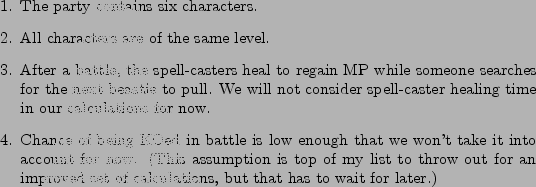
Figure 1 shows some assumptions.
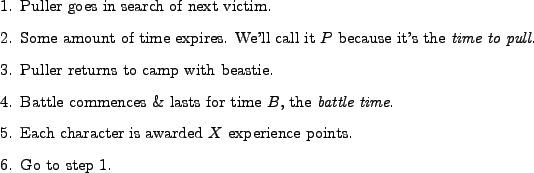
The whole operation of battling beastie after beastie can be reduced to the process in Figure 2.
The rate of gaining experience points is
 .
Obviously, players want to maximize this rate.
.
Obviously, players want to maximize this rate.
Table 13 doesn't tell us much because it assumes that a battle is always 60 seconds. In fact, battles will be shorter for easier foes & longer for tougher foes.
Table 2 is like Table 1 except that it uses longer battle times for tougher foes. The battle times are shown in parantheses after the experience points; the times are in seconds.
|
Notice that for any rate in one column, you can find the same or a higher rate in a column to the left at a shorter poll time.
For example, if every 2 minutes you can find a
200 XP beastie, you'll earn XP at a rate of
 , but if you settle for 100-XP beasties
& can find one per minute, you'll earn XP at the same rate.
, but if you settle for 100-XP beasties
& can find one per minute, you'll earn XP at the same rate.
What does this mean? It means that if you've been looking for a 200-XP beastie for one minute, you might as well take the next 200-XP or 100-XP beastie you see.
In fact, the table skews the rates in the favor of the high-XP monsters because it does not take into account death. When your character is KOed, you lose XP. That destroyes the progress you made from your most recent battles, thereby lowering the rate at which you earned XP. The chance of death at a tougher monster is much greater than with a weaker monster.
Also, the table does not take into account the ``take the next 200-XP or 100-XP'' beastie factor. If you have been searching for a minute & decide to take the next 100-XP or 200-XP monster you see, then sometimes the next monster will be worth 200-XP, which will give you a higher rate than if the next monster was always 100-XP.
It would be interesting to see a similar table which takes death & the ``take the next ...'' factor into account. I would also like to use more accurate battle time estimates. (The battle time estimates I'e shown are my gutt fealings from the last week of parties I've seen.)
So much for tables of numbers. Now let's solve for symbolic answers.
Let's make some new variables. They are in Table 3.
|
In Table 3, ``tough'' & ``easy'' do not mean that the monsters checks as Tough or Easy. It just means that Monster A is tougher than Monster B; Monster B is easier than Monster A. You must spend more time in battle to defeat the tougher monster, but you'll earn more experience.
We want to find the pull-times for the tougher & easier
monsters such that it's worth your time to take the easier
monster even though you'd rather take the tougher monster.
In other words, we want to know  &/or
&/or  such
that
such
that
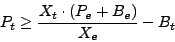
 .
Since we already defined the variables in
Table 3, the answer is just some algebra away.
.
Since we already defined the variables in
Table 3, the answer is just some algebra away.
 |
(1) |
 |
(2) |
 |
(3) |
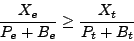
Equation 4 tells us exactly when to stop looking for just the tougher monster & to accept easier monsters, too.4, but it doesn't mean much to the human eye unless we plugin some numbers.
But I guess I'll do that later.
A Warrior's Provoke ability is a White Mage's best friend.
Silence is a mage's worst enemy.