Copyright © 2003 Gene Michael Stover. All rights reserved. Permission to copy, store, & view this document unmodified & in its entirety is granted.
Here are descriptions of Tarot spreads I have encountered, including information about where I encountered them. I hope to find historical information about the spreads, too, & document it.
If you want to learn about Tarot cards from the ground up, I recommend Tarot for Dummies ([Jay01]).
I'm cheap when it comes to time on graphical things, so the figures that show the spreads are simple. Each element in the figure shows a number. Those numbers show the order in which you lay out the cards.
If a number is in parentheses, it means you don't put that card on the table unconditionally. Read the description for that layout to learn how, when, or whether to draw that card.
I read about this spread in [Gra71]. It's short & quick, & it provides a yes-or-no answer.
Shuffle the question into the cards.
Turn cards from the deck into a pile on the reader 's right until you encounter an ace or you have turned a thirteenth card.
Start a pile to the left of the first. Once again, turn cards until you encounter an ace or you turn a thirteenth card.
Start a third pile to the left of the second. Once again, turn cards until you encounter an ace or you turn a thirteenth card.
If none of the three piles show an ace, the Tarot cannot answer the question at this time.
If at least one ace is showing, the right-most ace contains the answer. Any aces to the left of the right-most ace contain information about the final outcome.
If one or two aces are showing, there will be a waiting period before the question is resolved. Presumably, if all three piles show aces, the question is resolved already.
I read about this technique in [Gra71]. It is a quick technique for divining answers.
Shuffle the question into the cards, then cut the deck into three parts. Line the three parts in front of the reader . Turn the parts over so the reader can see the faces.
For each pile, remove the card from the bottom & place it above the pile.
Now the reader sees six cards. All the cards are face-up.
The two cards on the right show the past. The two cards in the middle show the present. The two cards on the left show the future.
This is a 5-card or 6-card spread I read about in Tarot for Dummies.
The pattern for placing the cards is in Figure 4.1.
Card 1 is the significator . It is chosen by the reader r the seeker It represents the seeker.
Card 2 represents past experiences relevant to the question at hand.
Card 3 is placed side-ways so that reversal do not affect it. It represents opportunity for growth.
Card 4 is future possibilities.
Card 5 is the overall comment. It is selected specially. Add all the numbers from cards 1 through 4. Count that many cards down from the top of the deck. The card where you stop is card 5. Alternatively, you could chose the major arcana card whose number is the same as the sum of cards 1 through 4. Place it in the spread.
Card 6 is an optional major arcana card. If card 5 is not a major arcana card, card 6 may be chosen from the major arcana. You can choose it with the sum you used for card 5 or in several other ways which are described in Ms Jayanti's book.
This is a complex spread I read about in Tarot for Dummies.
The spread itself is fairly simple. You frame one or more questions, each for a different house of the Zodiac. Then you shuffle & cut the cards & draw some cards. You interpret each card with respect to the Zodiac house for which it was drawn.
That part is simple. The complex part is mapping the Tarot cards to the Zodiac. Ms Jayanti devotes an entire chapter of her book to it. Refer to that book for the full explanation.
This is a 3-card spread I read about in Tarot for Dummies.
This spread is designed to help choose between three possibilities in a situation. The seeker is aware of one or two possible choices. The cards in the spread will comment on each choice & hopefully hint at a new choice.
The pattern for placing the cards is in Figure 6.1.
Card 1 is a comment on one of the choices of which the seeker is already aware.
Card 2 is a comment on the other choice of which the seeker is already aware.
Card 3 is a comment on a new, as yet unknown or unacknowledged choice.
I suspect this is the most popular, or at least the most well-known, spread because I have seen it mentioned in at least two books ([Gra71,Jay01]) & have heard many people mention it in conversation. Even people who know next to nothing about Tarot seem to have heard of the Celtic Cross spread.
Because the Celtic Cross spread is so well-known, there are surely many variations on it. I have seen two variations of this spread so far.
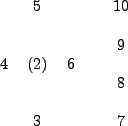
Figure 7.1 shows the order in which to place the cards. This appears to be common to all variations of the Celtic Cross spread.
Here is the Celtic Cross spread as described by Gray in [Gra71]. (Gray calls it the Keltic spread.)
Before you draw the cards & place them into the layout, choose a significator & place it in the middle of the table.
Card 1 is under card 2, so I haven't shown it. It is drawn from the deck & placed on top of the significator. Card 1 shows the situation, the mood of the seeker 's question .
Card 2 is sideways so that it is immunee to reversals. Card 2 shows forces at work beyond the seeker's control; they may be helpful or harmful.7.1
Card 3 shows the root of the situation. It is already part of the seeker's experience. In short, card 3 shows part of the past that is relevant to the situation.
Card 4 shows an event or other part of the situation which has recently passed or is passing.
Card 5 shows part of the possible future.
Card 6 shows part of the definite future.
Card 7 shows the seeker's fears about the situation.
Card 8 shows the influence of someone close to the seeker, her friends or family.
Card 9 shows the seeker's hopes. So card 9 is effectively the opposite of card 7.
Card 10 shows the ultimate outcome of the situation. Its interpretation should be influenced from the previous cards in the spread.
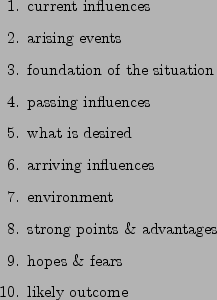
In Tarot for the Green Witch ([Mou03]), Ann
Moura describes a variation of the Celtic Cross spread.
The card positions are as I've described, but she ascribes
slightly different meanings to the positions in the layout.
Ms Moura's positional meanings are in
Figure ![[*]](../img/latex2html/crossref.png) .
.
Why is it called the Celtic Cross spread? Did Celts use it?
If it isn't from the Celts, what is this spready's origin?
In [Jay01], Ms Jayanti describes a Chakra spread.
I've seen this three-card spread mentioned in so many places that I have lost track of them. It's a simple, quick spread.
You lay out three cards in a row. From left to right, they are the past, the present, & the future.
This spread is simple enough & obvious enough that I suspect it is widely used. The places I have seen it used or discussed didn't mention reversals, but reversals are popular these days, so I'm sure people reading this spread often take reversals into account.
This is a 4-card spread I read about in Tarot for Dummies. She attributes it to a college student who majored in psychology.
The idea behind this spread is to help you view a situation from the multiple viewpoints of the multiple facets of your mind (subconscious, conscious, & superconscious; or id, parent, & adult; or whatever you want to call them depending on whether you prefered Freud, Jung, or whoever).
The pattern for placing the cards is in Figure .
Card 1 is your subconscious self or your child self.
Card 2 is your conscious self or your adult self.
Card 3 is your superconscious self or your wise self.
Card 4 is a comment on the situation.
This spread is described in Tarot for Dummies. It is intended to help answer questions about a relationship.
It can be done for two or more people. Each person involved draws seven cards & places them in a column on the table. Figure 11.1 shows one column. Remember that each person involved does a column.
Card 1 is the significator for the person.
Card 2 is physical aspects for the person & her partner with respect to the question at hand.
Card 3 shows mental aspects of the person & her partner with respect to the question.
Card 4 shows the spiritual aspects of the person & her partner.
Card 5 is sideways so that reversals do not affect it. It shows a lesson that might be learned by the person in this relationship.
Card 6 describes the means by which the lesson from card 5 might be learned.
Card 7 is a comment on the situation or the question as a whole.
I read of this layout in the pamphlet that accompanied a Thoth Tarot deck .
According to the pamphlet, this is a simplified version of a spread that was popular among the members of the Golden Dawn. The more complex spread required several hours to execute.
Figure 12.1 shows the order for placing the cards.
Take note that this layout ignores reversals but takes ill-dignified cards into account.
Card 1 represents the seeker The pamphlet implies that it is drawn randomly like the other cards, but if this is a significator , then it could have been chosen by the seeker or the reader .
Cards 2, 3, & 1 describe the situation & the personality of the seeker.
Cards 4, 8, & 12 represent one possible outcome in the future. It is almost surely an outcome that will happen if the seeker takes no action.
Cards 13, 9, & 5 represent another possible outcome in the future. If it is in disagreement with the (4, 8, 12) group, then the (13, 9, 5) group show an alternative outcome that could arise if the seeker takes action to prevent the outcome of the (4, 8, 12) group.
Cards 14, 10, & 6 show a psychological basis for the situation. They may provide a helpful suggestion for the seeker in determining what actions to take.
Cards 7, 11, & 15 show forces or actors that are outside of the control of the seeker. They will happen or are happening, & there is little the seeker can do about them. The seeker could adapt, so in that respect these cards could provide valuable information.
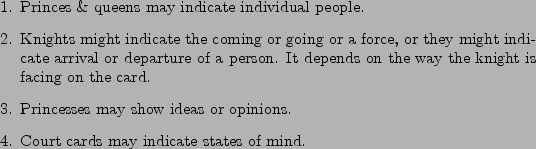
Other suggestions from the pamphlet are in Figure 12.2.
This is my favorite Tarot spread because each group of three cards relates to a definite concept (situation, outcomes, basis, & independant forces), & you have three cards for each of those concepts. Three cards gives you a lot of information to work with.
Note: I'd like to get a description of the full, complex version. A spread that required hours to perform? I need to see that.
This is a single-card spread I read about in Tarot for Dummies.
The idea is to do a touchstone spread in the morning to determine the mood or outlook for the day. I presume the seeker & reader in a touchstone spread are usually the same person, though Ms Jayanti doesn't say so explicitly.
To do a touchstone spread, relax, meditate, & draw a single card. Then contemplate the card.
This quick yes-or-no spread is from [Gra71].
After shuffling the question the question into the cards, pick three cards at random. Gray suggests spreading them, face down, on the table & picking three. I imagine it would serve equally well to pick the top three cards from the deck.
Turn over the three cards, being careful to preserve their orientation. (In other words, reversal s are important.)
If all three cards are right side up, the answer is Definitely Yes.
If two of the cards are right side up, the answer is Possibly Yes.
If two of the cards are up side down, the answer is Possibly No.
If all three of the cards are up side down, the answer is Definitely No.
Here are some tables comparing attributes of the different spreads.
| spread | number of cards | reversals? |
| Touchstone | 1 | no |
| Between Extremes | 3 | yes |
| Past Present Future | 3 | |
| Yes or No (Gray) | 3 | yes |
| Psychological Spread | 4 | yes |
| Amber's All-Purpose | 5 or 6 | yes |
| 6-Card Hungarian | 6 | yes |
| Celtic Cross | 10 | yes |
| Relationship | (14) | yes |
| Simplified Golden Dawn | 15 | no |
| Astrological | ||
| Chakra | ||
| 3 Aces | (78) |